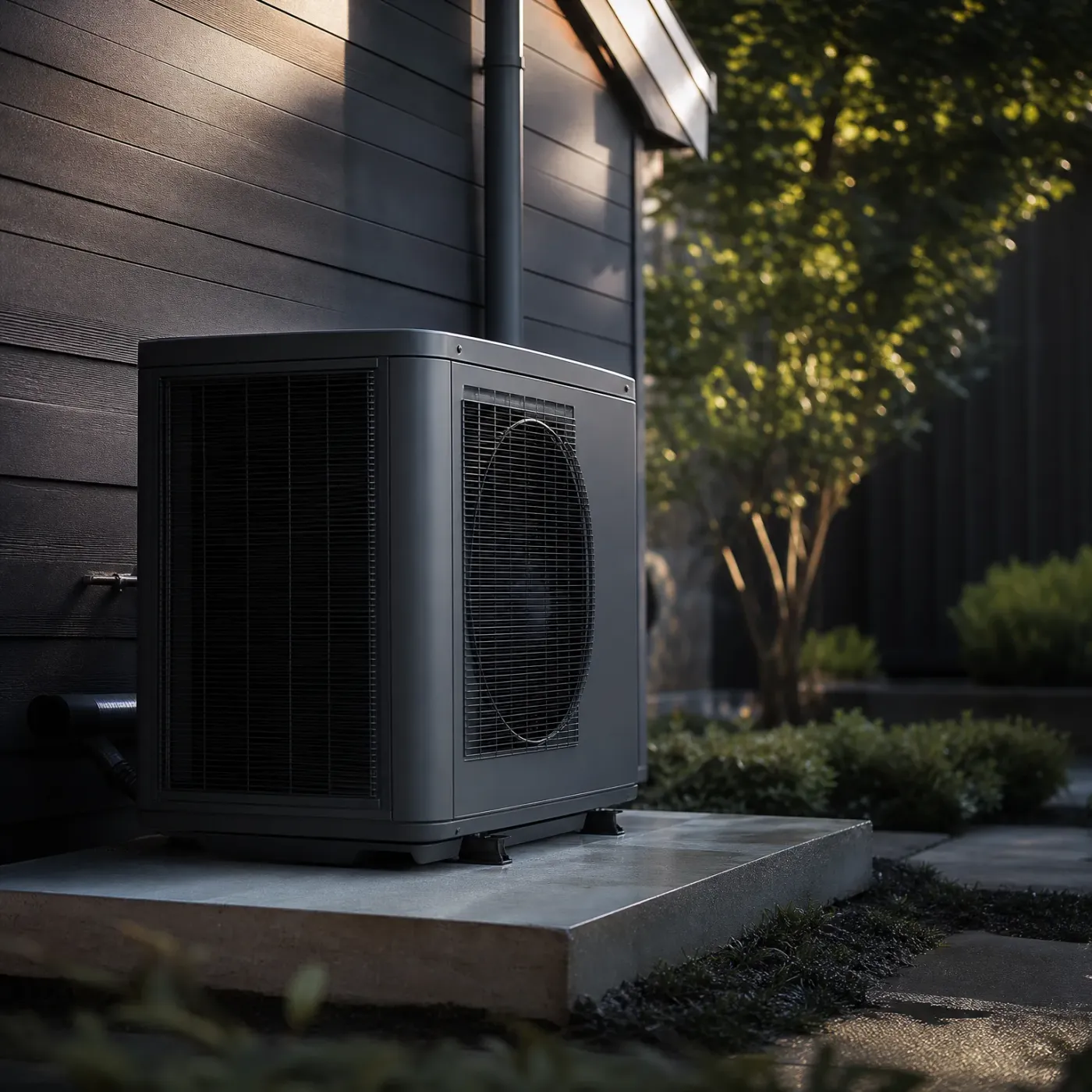









A gray outdoor condenser/heat pump unit with a side fan grille sits on a concrete pad beside a dark horizontal wood-sided house, with shrubs and a small tree nearby.

Explain it one time

What auxiliary heat means on a Mississippi heat pump

Your thermostat shows "AUX" or "EM HEAT" and you want to know what your heat pump is doing and whether it's a problem. This page gets into why auxiliary heat kicks in, what it means for your electric bill in Mississippi, and when it points to something that needs a repair. If you'd rather skip the search and have a local contractor who works on heat pumps look at yours, you can get matched with one here instead of calling around and explaining the issue to several companies.

Start one form

Auxiliary heat is backup heat. Your heat pump has electric strip heat built into the air handler, and the thermostat calls for it when the heat pump alone can't keep up or can't heat the air fast enough on its own. In most of Mississippi that's not about deep cold the way it would be farther north. It's more likely to show up on the rare hard freeze, when you bump the thermostat up several degrees at once, or when the heat pump is struggling and leaning on the strips to cover for it. Aux heat by itself isn't a malfunction. It's a normal part of how the system is built. But electric strip heat costs more to run than the heat pump running on its own, so if "AUX" is on for long stretches, or on mild days when it shouldn't need to be, that's worth a look. It usually means the heat pump side isn't pulling its weight.

A gray outdoor air conditioning condenser unit on a concrete pad beside a house with light vinyl siding, with a gray electrical disconnect box and conduit on the wall to the right.
Before you get your heat pump repair
A gray outdoor condenser unit on a concrete pad beside a light-green sided house, surrounded by mulch, ornamental grasses and a shrub, with mowed lawn in the foreground.
After you get your heat pump repair

Why strip heat costs more to run

The strip heat in your air handler warms air with electric resistance coils, the same idea as a space heater. A heat pump moves heat instead of making it, which is why it costs less to run than the strips. When AUX stays lit for long stretches, you're paying space heater rates to heat the house instead of heat pump rates. One mild evening where it kicks on for twenty minutes isn't going to move your bill. AUX running most of the night, repeatedly, through a stretch of cold weather will show up on it.

What a short cycle on cold mornings tells you

A heat pump loses capacity as the outdoor temperature drops, and on a cold Mississippi morning it's normal for AUX to help out until the house catches up to the thermostat setting. What's not normal is AUX kicking on for mild weather, or the outdoor unit running nonstop without ever satisfying the thermostat. That points to the heat pump itself falling short, whether that's low refrigerant, a failing compressor, or a defrost cycle that isn't clearing frost off the outdoor coil. A local contractor who services heat pumps all winter can tell the difference by checking charge and airflow rather than guessing.

A gray-haired man in a dark long-sleeve shirt sits on a gray sofa in a living room, looking toward a sunlit window with sheer curtains.
A gray-haired man in a dark green sweatshirt sits on a sofa in a living room, looking toward a bright window, with a houseplant, lamp, fireplace and framed art behind him.
A gray-haired bearded man in a dark green collared sweater sits on a sofa in a living room with a window, houseplant, floor lamp and bookshelves, looking off to the side.
A gray-haired man in a dark green sweater sits on a sofa in a sunlit living room, looking off to the side, with a framed landscape painting, dining table and shelving behind him.

Skip the calls to every shop

If your thermostat is stuck on AUX or EM HEAT more than it should be, the next step is getting a contractor to look at the heat pump itself, not just the thermostat settings. That usually means calling around to find someone who works on heat pumps specifically, explaining the same thing to each one, then waiting on quotes to compare. A heat pump that leans on strip heat too much can point to a low refrigerant charge, a failing defrost sensor, or a reversing valve that's not switching the way it should, and sorting out which one it is takes someone who sees this equipment all winter in Mississippi homes. Asking here sends your request to one licensed local contractor instead of several, so you're not fielding a round of calls to sort through. You still need the repair done. What this clears out of the way is the part where you track down who to call.

If AUX is on for an hour because it's 28 degrees outside, that's the strips doing their job and your bill reflects that one morning, not the whole month.

If AUX is on most of the day when it's 50 outside, the heat pump isn't carrying the load it should, and every hour of that is strip heat priced into your bill instead of heat pump electricity.

A middle-aged woman with shoulder-length dark hair, wearing a gray cardigan over a cream top, sits in an upholstered armchair and looks toward a sunlit window, with a shelf holding framed pictures and a plant behind her.
A woman and a child wrapped together in a knitted gray blanket on a couch, with the child's head resting on her shoulder and a lit table lamp and houseplant in the background.
A gray outdoor heat pump unit on a concrete pad beside a house with horizontal lap siding, connected by conduit and a flexible line to a wall-mounted disconnect box, with low shrubs and mulch nearby.

Heat pump carrying the load

This is what it looks like when the heat pump is doing the work on its own. The outdoor unit runs, the fan turns, and the strips in the air handler stay off except on the coldest mornings. Your bill reflects normal heat pump use, not electric resistance heat.


An outdoor air conditioner condenser unit on a concrete pad beside a house with beige horizontal siding, with conduit running from an electrical box on the wall.

Heat pump stuck on strips

The outdoor unit is quiet more than it should be, and AUX or EM HEAT stays lit through mild weather. That means the strips are carrying heat the heat pump is built to carry. A contractor who works on heat pumps in your area can tell you whether it's low refrigerant, a failing part outside, or a stuck setting.

Power costs 14.03 cents per kilowatt-hour statewide

At 14.03 cents a kilowatt-hour, every hour those strips run costs you more than an hour of the heat pump alone. That gap is why it matters whether AUX is coming on for one cold morning or running most of the day.

EIA-861 2025 statewide residential average

A wooden table in the foreground holds a closed laptop and a ceramic mug of coffee, with a spindle-back wooden chair behind it, a beige wall with paneled wainscoting, a window at left, and a kitchen counter with a cutting board, bowl of fruit and greenery at right.

AUX on your thermostat just means the strips are helping out

That's what the letters mean, every time you see them. The question that matters is whether it's happening because it's genuinely cold out, or because the heat pump can't hold up its end anymore. One answer costs you an hour of strip heat. The other costs you most of the winter.

Finding out takes someone standing in front of the unit, not another look at the thermostat. Instead of searching around for a heat pump contractor, calling a few, and going through the same explanation about your AUX light with each one, you can have one licensed contractor local to Mississippi take the call. Someone who works on heat pumps through the winter here knows what tends to fail first and what to check before anything else. You get a straight answer about what your system is doing, and where you stand once it's fixed.

A wooden table holding a stone vase with a bare branch, two stacked books and a small dark bowl, beside a window with green foliage outside and a sofa in the dim background.
An outdoor heat pump unit with a large circular fan sits on a concrete pad beside a dark horizontal-sided building, with gravel ground and green shrubs at right.

Skip calling around

Only one pro gets your request, so you hear from one company.

Step 1 of 3: Equipment

