Profile view of a bearded man wearing a dark green baseball cap and a dark gray T-shirt against a plain light background.

Repair or replace a heat pump in Mississippi

Step 1 of 3: Equipment

Most of the time a heat pump problem in Mississippi is worth fixing. A bad capacitor, a low refrigerant charge, a failed defrost board, these are common repairs and your system keeps running for years after. Replacement makes more sense when the compressor itself has failed, or when the unit is old enough that the repair bill starts to rival what a new system costs. Since most homes here heat with electricity as well as cool, a heat pump that is losing efficiency hits you twice, once in summer and once in winter. Mississippi summers run hot and muggy for months, so a unit that is already struggling to keep up in July usually isn't going to get easier to live with. If your heat pump is older and the repairs keep coming, it's worth having someone look at the whole system, not just the part that broke this time.

A man with grey hair and stubble in a dark sweater sits on a grey sofa indoors, looking off to the side, with a potted plant and a sunlit window behind him.
A man with gray hair, a beard and glasses, wearing a dark green sweater, sits on a gray sofa in a sunlit living room with a potted plant, table lamp and wooden sideboard behind him.
A middle-aged man with graying hair and a short beard sits on a blue sofa in a living room, looking toward a window, with a bookshelf, lamp and framed picture in the background.
A man with graying curly hair and a dark green sweater sits on a gray sofa in a sunlit living room, looking off to the side, with a framed picture, shelving, an armchair and a window with sheer curtains behind him.

When the repair holds up

A heat pump in Mississippi runs most of the year, cooling through the muggy summers and carrying the heat load for homes that run on electricity. That kind of use wears specific parts: the capacitor, the reversing valve, the defrost board. Swapping one of these doesn't shorten the life of the compressor or the coil, which are the expensive parts to replace. If those are sound, a repair gets you back to normal and the system keeps going. A contractor who services this equipment every season can tell you quickly whether what failed is one of these parts or something tied to the compressor itself.


When the compressor is the problem

The compressor is sealed inside the outdoor unit and does the actual work of moving heat in and out of your home. It isn't something a contractor swaps out on its own the way they would a capacitor or a board. When a compressor fails, or when the refrigerant coil it's paired with is leaking or corroded, the cost of fixing just that one part starts to close in on the cost of a new system. At that point a contractor is weighing one repair against a unit that has years of use left in every other part.

An outdoor air conditioning condenser unit with dusty coils sits on a concrete pad against light horizontal siding, with an electrical disconnect box and refrigerant lines on the wall and a shrub and mulch at left.
Before you get your heat pump installation
A gray outdoor heat pump unit on a concrete pad beside a house with horizontal lap siding, with a conduit running to a wall-mounted disconnect box and a green shrub to the left.
After you get your heat pump installation

A heat pump doesn't burn anything to make heat. It moves heat from one place to another, and in winter that means pulling warmth out of outside air even when it's cold enough outside that this seems impossible. The reversing valve is what controls direction, switching the system between cooling your home and heating it. When that valve sticks, you get cold air blowing on a day you've got the thermostat set to heat. Frost building up on the outdoor coil in winter isn't a sign anything's wrong. The system runs a defrost cycle on its own, reversing briefly to clear the coil before going back to heating. That cycle depends on a defrost board, and when the board fails, the coil can ice over completely and choke off airflow, which looks like a refrigerant issue but isn't one. A unit running low on charge shows it most in July and August, when it's working the hardest against the heat and humidity. And since most houses here heat with electricity instead of gas, a heat pump failing in January is the same kind of problem as an AC failing in August.

How a heat pump actually runs

  • A heat pump moves heat instead of making it, so in winter the outdoor coil is pulling heat from outside air even when it feels too cold for that to work.
  • The reversing valve is what switches the system between heating and cooling, and when it sticks, the unit can blow cold air when you have it set to heat.
  • Frost on the outdoor coil in winter is normal, but the unit should run a defrost cycle on its own, briefly reversing to melt it off before going back to heating.
  • If the defrost board fails, the coil can ice over solid and block airflow, which is often mistaken for a refrigerant problem.
  • A heat pump that's low on charge will struggle hardest in July and August, when it's working longest to keep up with the heat and humidity.
  • Because most homes here run on electric heat, the heat pump is doing the job a furnace would do elsewhere, so a breakdown in January hits the same way an AC breakdown would in August.
A gray outdoor condenser unit on a concrete pad beside a house with horizontal lap siding, with a wall-mounted disconnect box, conduit and insulated refrigerant lines, a shrub at left and gravel at right.
A heat pump that cycles on and off normally, holding the temperature you set without the outdoor unit running nonstop, is doing its job.
An outdoor air conditioning condenser unit on a concrete pad beside a house with horizontal lap siding, with a green shrub to the left and a wide concrete slab in the foreground.
A unit icing over in winter or blowing warm air in summer is telling you something's failed, and running it this way just adds strain.
  1. A contractor checks the refrigerant charge and electrical connections first.

  2. The reversing valve and defrost board get tested under load.

  3. Worn parts like the capacitor get replaced if they're weak.

  4. The system runs a full cycle to confirm the fix holds.

Repair the Heat Pump or Replace It

Repair

  • A compressor that still runs fine but has a bad capacitor or a stuck reversing valve usually just needs that one part replaced.
  • Repairs get the system back to normal operation fast, which matters when it's the dead of summer or a cold snap and you're running on electric heat.
  • A contractor can often confirm within one visit whether the fix is a single part or something bigger.
  • Parts like the defrost board, the capacitor and the contactor are common failure points and don't mean the whole unit is failing.
  • If the outdoor unit is still within its expected working life, a repair protects what you already paid for instead of starting over.

Replace

  • A failing compressor is the one repair that usually costs more than it's worth, since it's the core of the whole system.
  • If the unit has needed several repairs in a short stretch, that pattern itself is a sign the system is wearing out, not just one part.
  • A new heat pump installed correctly will run more efficiently than an old one patched together with replacement parts.
  • Since most homes in Mississippi heat with electricity, a heat pump that's losing efficiency shows up directly on the power bill.
  • Replacement also resets the clock, so you're not guessing which part fails next.
A gray outdoor condenser unit sits on a concrete pad against a house wall with horizontal siding above a stone veneer base, with an electrical disconnect box and conduit on the wall and a leafy shrub in mulch to the left.

Running clean

This is what a heat pump should look like, sitting on its pad with clear airflow on all sides. The coil fins are open, the disconnect box is intact, and nothing is blocking the cabinet. A unit kept like this can usually be repaired when something inside fails.

An outdoor air conditioner condenser unit on a concrete pad beside a house with beige vinyl siding, with a gray electrical disconnect box and insulated refrigerant lines on the wall and river rock to the right.

Clogged and struggling

Dirt and debris have packed into the coil fins on this unit, cutting off the airflow it needs to move heat. A heat pump working this hard against a blocked coil puts strain on the compressor, and that's the part that decides whether replacement is the better call.

A woman with shoulder-length brown hair wearing a beige knit cardigan sits in a gray upholstered armchair near a window, looking off to the side with a slight smile, with bookshelves blurred in the background.
A woman and a sleeping child wrapped together in a cream knitted blanket on a couch, with a potted plant, framed photo and lit lamp in the background.

Let someone else find the pro

One installer gets your project, so there's no bidding war over it.

No charge to send it. You decide if you hire them.

A single-story red brick ranch house with a gray shingled roof, white-framed windows and a central dark front door, fronted by a wide asphalt driveway, green lawn and large deciduous trees on both sides under a bright hazy sky.

Summer air here holds a dew point around 70°F, according to NOAA climate data for Mississippi. That's thick, sticky air, and your heat pump has to pull a lot of moisture out of it before the house feels cool. The coil stays wet for hours at a stretch instead of drying out between cycles, and that's what shortens its life. You'll notice the system running longer stretches than you'd expect for the temperature on the thermostat, because it's working on the humidity as much as the heat. If the coil or the drain line isn't keeping up, you'll see water pooling near the indoor unit or the air feeling cool but still damp.

NASA POWER T2MDEW county cells weighted by homes

Why does my heat pump blow cool air before it warms up in winter?

A heat pump running in defrost mode or just starting a heating cycle will blow air that feels cool, sometimes even cold, against your skin. People notice it most on a cold Mississippi morning when the system kicks on and the vents don't feel warm right away, and it's easy to assume something's wrong or the unit is struggling to keep up with the house.

That cool air is normal, up to a point

A heat pump heats by moving warm air across the indoor coil, and that coil has to come up to temperature before the air feels warm to you. Right after start up, or right after a defrost cycle ends, the air coming out can sit well below body temperature even though the system is working correctly. It should climb to a warm supply temperature within a few minutes. If it stays cool the whole time the unit runs, or the outdoor coil is covered in ice that won't clear, that points to a stuck reversing valve or a defrost board that isn't cycling the way it should, and that's a repair worth having looked at before it leaves you heating with backup strip heat alone.

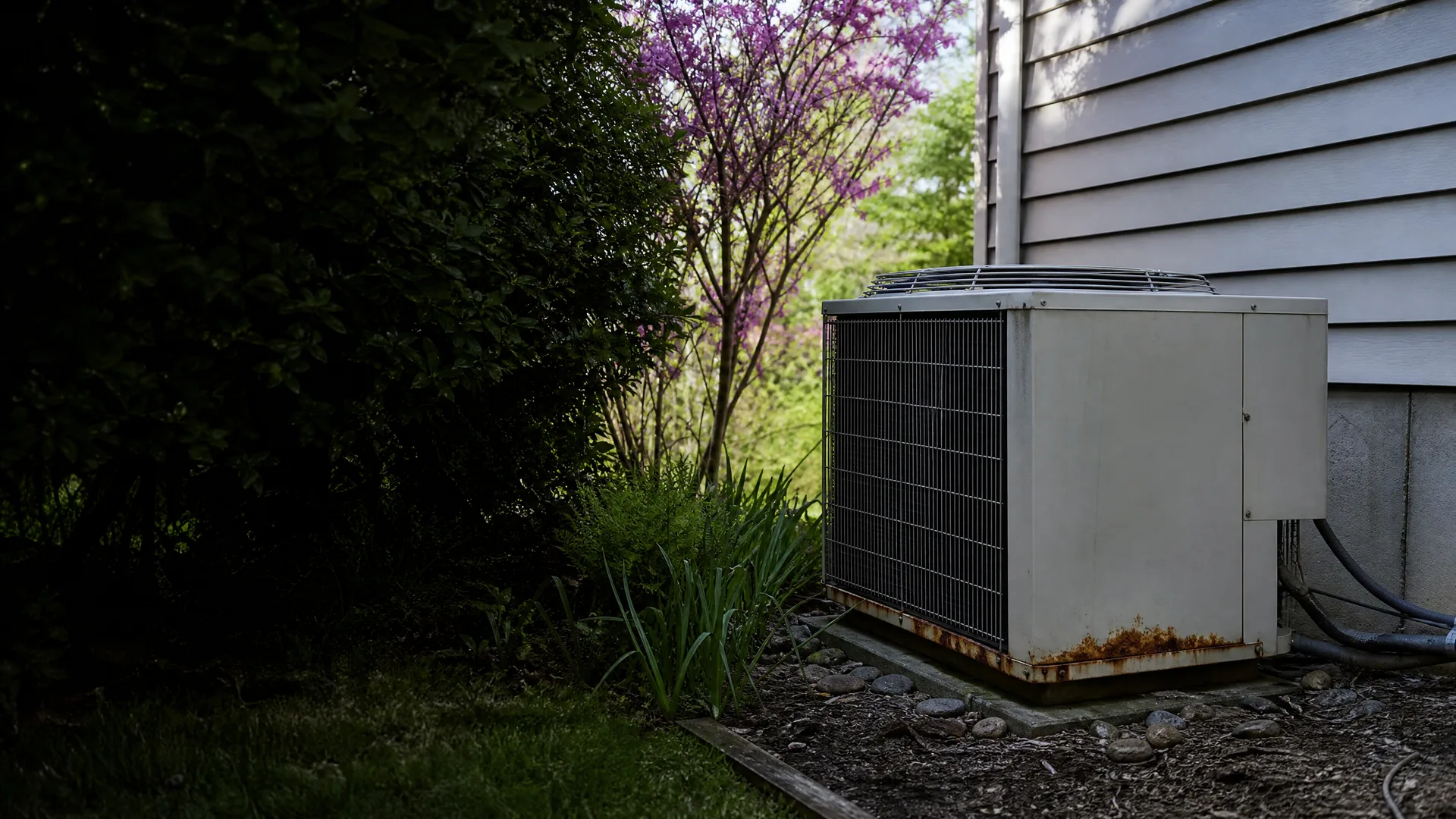
An outdoor air conditioning condenser unit with rust streaks sits on a concrete pad beside a light-colored lap-sided house, surrounded by shrubs, gravel and a flowering tree.

You're out checking the side yard in April, coffee still in hand, when you notice the rust along the base of the outdoor unit. It's been there a while probably, just never caught your eye before. The grass around it is greening up again, and the unit's humming along like it always does. You crouch down and run a thumb over the rust, feeling how far it's eaten into the metal. The cabinet still looks solid higher up. You straighten up, figuring you'll mention it next time someone's out to look at the system, and head back inside before the coffee goes cold.

Power costs 14.03 cents per kilowatt-hour statewide

At 14.03 cents per kilowatt-hour, running your heat pump costs about what it does for most of your neighbors. A new install that's sized right and properly charged keeps that number steady instead of letting a weak unit push your bill up every month it struggles.

EIA-861 2025 statewide residential average

Where Your Heat Pump Stands

  • A heat pump that's cycling normally and holding its set temperature doesn't need anything done to it right now.
  • Icing in winter, warm air in summer, or short cycling means something specific has failed and needs a look.
  • Most problems, from a weak capacitor to a stuck reversing valve, get fixed without replacing the whole system.
  • A compressor failure or a unit that's aged out is when installing a new system is the better call.
  • A local contractor who works on heat pumps all year in Mississippi knows which parts give out first in this climate.
  • You'll hear back from one contractor, not a string of calls from several companies trying to win the job.

A heat pump that's holding its set temperature and cycling the way it should is fine as it is. If yours is icing up in winter, blowing warm air in summer, or running in short bursts that never quite get the house comfortable, something specific has given out, and that's worth a look rather than a guess. Most of the time the fix is one part. A capacitor that's gone weak, a reversing valve that's sticking, a defrost board that's stopped doing its job. These get repaired and the system goes back to carrying your summers and winters the way it has been. A new install becomes the right call when the compressor itself has failed or the unit has simply aged out, and at that point a repair is just delaying the same decision.

Either way, the work goes to a contractor who's local to Mississippi and knows this equipment because he's out servicing it through the muggy summers and the cold snaps every year. He's seen which parts tend to go first in this climate and what a straight repair looks like versus a system that's done. You'll hear from that one contractor directly, not a handful of companies competing for the same job. That's one call to make, one person who already knows what he's walking into when he gets there, and a heat pump that gets sorted out instead of sitting broken while you figure out who to ask.

Kitchen corner with cream upper cabinets, oak lower cabinets, white marble-look countertop, beige tile backsplash, a ceramic vase of greenery, a wooden cutting board and bowl, and a black-framed window at right.
Interior corner of a room with a white-framed window and wide sill, beige walls with panel molding, a wooden cabinet holding a ceramic vase with a green leafy plant, and blurred shrubs and trees outside.
A wood-framed armchair with beige cushions and a woven lumbar pillow sits in a corner beside a large window overlooking green trees, with a tall ceramic vase holding leafy branches on the left and plaster walls and wood flooring.
Interior corner with a white-framed window above a sill, beige walls with baseboard molding, a greige shaker-style cabinet with brass knobs and a potted plant on top, light wood flooring and a woven jute rug.
A dark-framed six-pane window with white trim and sill set in gray horizontal lap siding, with hydrangea shrubs below and a white column and shingled roof section at left.

One request and it's handed off

The pro who reaches out is licensed in Mississippi.

I'm done searching

There's no charge for the request.